
Ripley County Three-Day Release Check
No official Ripley County current roster, 72-hour released view, archive, app, or published roster vendor was located. Extending a search from one day to three days does not change that source finding. It changes the scope of the inquiry. The practical task is to ask the sheriff about a precise period and, when needed, seek the existing records for releases or transfers during that period.
Start with the Ripley County Sheriff at 573-996-2129 and ask for detention or records. A separately published sheriff or jail number is 573-996-5555. For a named person, ask whether Ripley custody ended during the defined window, the physical release date and time, and whether the disposition was community release or transfer. For a list, ask whether an existing report or export covers the exact three-day span.
Check Ripley County 72-Hour Releases
A useful three-day check fixes the time range before any call or request. “Over the weekend” can be vague. Use calendar dates and, when relevant, the start and end times. That lets staff locate an existing report and helps prevent an arrest, transfer, or court event from being mistaken for release.
- Set the window. Write the exact beginning and end of the 72-hour span.
- Confirm Ripley custody. Make sure the Ripley County Detention Center was the former custodian.
- Call the sheriff. Ask for detention or records and request physical release or transfer confirmation.
- Separate outcomes. Record whether the person entered the community, went to MODOC, moved on another warrant, or entered other custody.
- Check the legal event. Search Case.net under Ripley County and review every known cause for orders, judgments, warrants, and later docket activity.
- Use notification data with limits. Check VINELink only if Ripley appears as an active reporting agency, and treat the result as agency-specific.
- Send a narrow request. Ask for an existing three-day release report or the relevant inmate files and activity log.
For a same-day event near the edge of the range, the Ripley County 24-Hour Releases page gives a shorter call script and explains Patrol and social-post limits.
Ripley County 72-Hour Record Fields
Ripley County has not published fields for a rolling three-day list because no such feed was verified. The right field table is therefore a request inventory. It describes what to seek from an existing jail report or file without claiming that all items appear together or are open in every case.
| Field to request | Why it matters across three days |
|---|---|
| Identity detail | Prevents similar names from being combined in the requested period. |
| Booking or admission date | Connects each outcome to the correct confinement. |
| Cause number | Links the jail event to the right Ripley County court case. |
| Release date and time | Places the physical custody event inside or outside the window. |
| Release or transfer code | Separates community departure from movement to another custodian. |
| Receiving agency | Provides the next official search target after a transfer. |
Missouri’s sheriff retention schedule supports categories such as intake, reason for confinement, admission and release dates, property, and transfer material. Ripley’s internal form design is not public. Phrase the request around facts and existing records, not an assumed software screen.
Ripley County Weekend Release Timing
A three-day range is most useful when a one-day view would split a weekend or holiday period. The wider span captures the date range in one inquiry. It does not establish that the jail follows a certain weekend release schedule, uses a set release door, or posts data on the next business day. None of those local practices was verified.
Case.net can explain a bond order, sentence, dismissal, or other legal authority. Yet a court timestamp is not the jail’s physical departure time. Staff may still have to process the order, and another case or hold may keep the person in custody. Likewise, an event recorded after a weekend may relate to an earlier physical release. Ask for both the custody-end time and the disposition.
When the person has several cases, review each one. Release in one cause does not clear a hold in another. If Ripley reports a transfer on a warrant, request the receiving jurisdiction rather than treating the Ripley departure as freedom.
Note: No verified local facts support a promise about weekend processing, release hours, transportation, property pickup, or public data-entry timing.
Ripley Release Records Outlast Web Views
There is no Ripley County web release archive to consult after 72 hours. The official record can still remain with the custodian. Missouri’s sheriff records retention schedule sets a five-year minimum after release for an inmate or detainee file. Arrest and booking sheets and jail activity logs also carry five-year minimums. Web visibility and agency retention are separate ideas.
The distinction matters more after immediate phone visibility fades. A defined request can seek the admission and release dates, release or transfer disposition, cause number, and receiving agency. It can also ask for an existing report or export of all custody endings within the stated window. If no report exists, request the relevant log or individual file rather than demand a new database product.
The statewide schedule was part of the official research even though its manifest screenshot failed and is not displayed here. That source supports the retention period. It does not guarantee public access to every field, require the sheriff to post the record online, or establish how Ripley stores the data.
Request Ripley County Release Records
Missouri Sunshine Law provides a practical route when no rolling feed exists. Send a focused request to Sheriff Rad Talburt’s office at 301 Lafayette Street, Doniphan, MO 63935, or rcso@sheriff.ripleycountymo.gov. Identify a named person and approximate confinement, or define the exact 72-hour span for a list request.
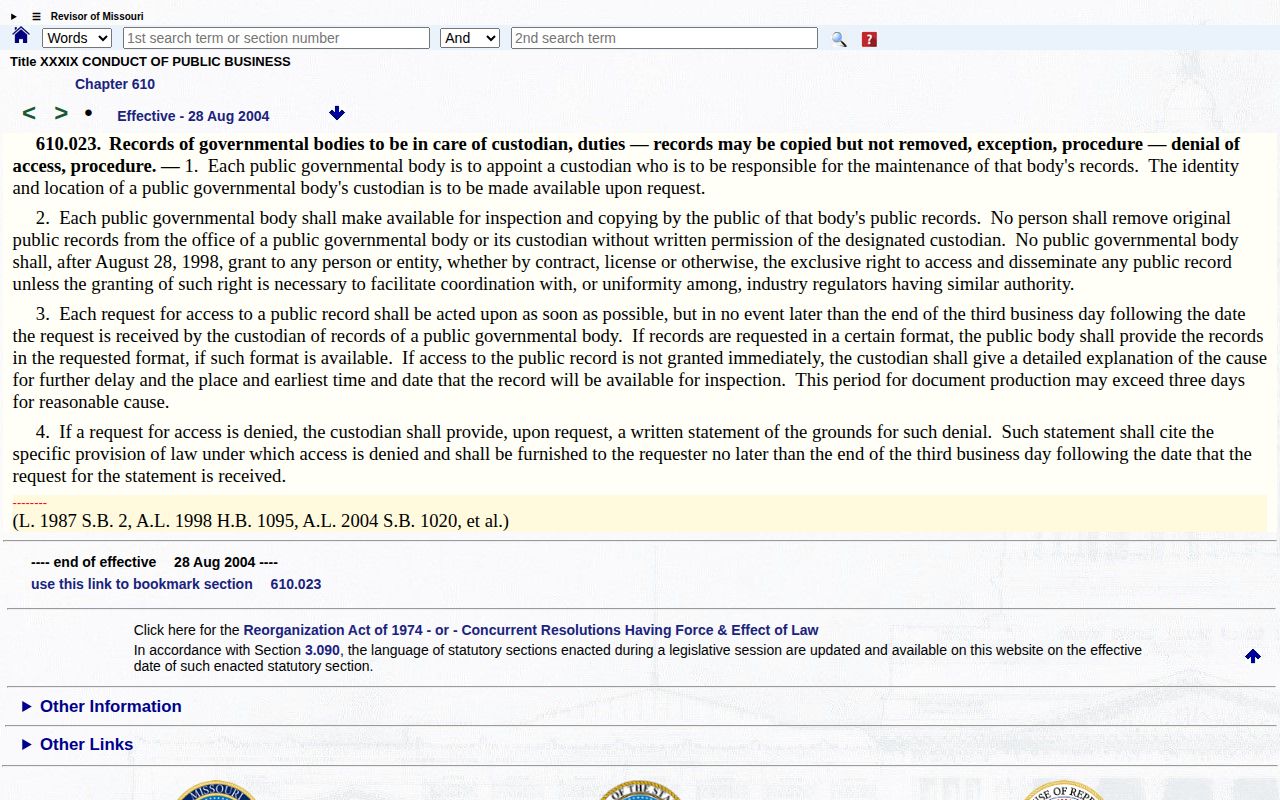
Section 610.023 governs the custodian’s response. It calls for access as soon as possible and generally no later than the end of the third business day after receipt. That rule does not promise completed production within three days. If more time is needed, the custodian should provide a detailed explanation and the earliest date and time the records will be available.
The official Section 610.023 page is shown in the captured source below:
The response deadline concerns the custodian’s action, not a guarantee that a large or complex export arrives at once. Keep the scope narrow and preserve any written delay or denial explanation.
Ripley Release Access and Costs
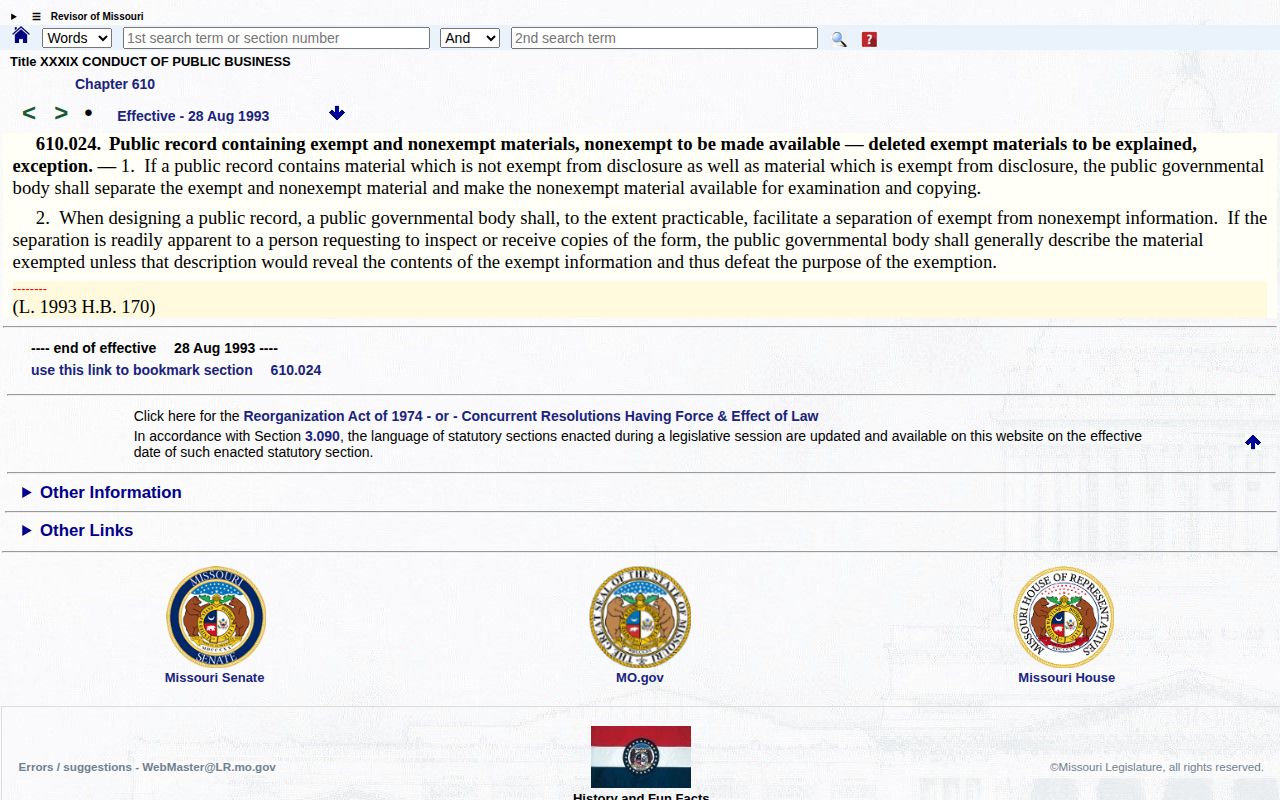
A jail record can contain both open and closed material. Missouri Section 610.024 addresses separation, often called segregation, of open information from material that may lawfully remain closed. Ask for the open portions even if some content must be withheld.
The captured Section 610.024 statute page shows that separation rule:
Costs depend on format and work. Section 610.026 permits charges for copies and certain staff, research, or programming time. The ordinary paper-page rate is not a universal cap on electronic work, images, or a nonstandard export. Ask for the lowest-cost method and a written estimate. An agency may require advance payment.
| Request choice | Cost effect |
|---|---|
| Existing three-day report | May require less work if the report already exists. |
| Narrow fields and exact dates | Reduces review and search scope. |
| Custom electronic compilation | May involve actual staff or programming charges. |
| Open portions only | Helps focus production when other material is closed. |
Do not assume a flat Ripley fee or published local fee schedule. None was verified. Obtain an estimate before authorizing work that could require special processing.
Ripley Release Search Gaps
The absence of a public Ripley roster creates a local data gap. Sheriff confirmation, a records request, Case.net, and VINELink only when Ripley participation appears live form the county chain. Each has a defined role. Case.net shows legal events, not the exact jail-door time. VINE reports data supplied by a participating agency and is not a guaranteed historical archive.
MODOC is a separate system. Its public offender search covers active incarcerated or supervised people and expressly excludes fully discharged people. A person released from state prison to parole or conditional release may remain searchable as active in the field. A person whose entire DOC relationship ended may not appear. Therefore, “not found” is ambiguous and cannot establish a Ripley release within the last three days.
The MODOC nightly working data has broader historical reach, including former supervision, but it is charge and sentence based. Its minimum and maximum sentence dates and completed-row flag do not prove a physical county-jail release moment. Use MODOC only when Ripley records or the court show a state-custody connection.
Confirm One Ripley County Release
A list request and a named-person inquiry are different. For one person, start with the last known custodian and match more than a name. Birth date, cause number, booking period, or agency ID can prevent a false match. The Ripley County released-inmate search sets out the broader county, state, federal, and immigration paths when the receiving custodian is not clear.
Once Ripley staff confirm the custody end, ask the essential second question: community release or transfer? Bond, recognizance, time served, and a court-ordered release can place someone outside the jail while legal duties continue. Transfer to MODOC, another county, federal custody, or ICE means the person left Ripley but remained held elsewhere.
That distinction keeps a three-day release check accurate. A wider time range is useful, but the agency and outcome matter more than the number of hours.